26th February 2026
Written by Caroline Lievesley
By bringing together university expertise from psychology, nutrition, careers, marketing and beyond, the sports team at the University of Nottingham has created an enriching, practical workshop series designed to equip athletes with skills that extend far beyond sport. From managing finances and building a personal brand to handling pressure and planning for life after sport, the programme ensures athletes leave with tools they can use immediately.
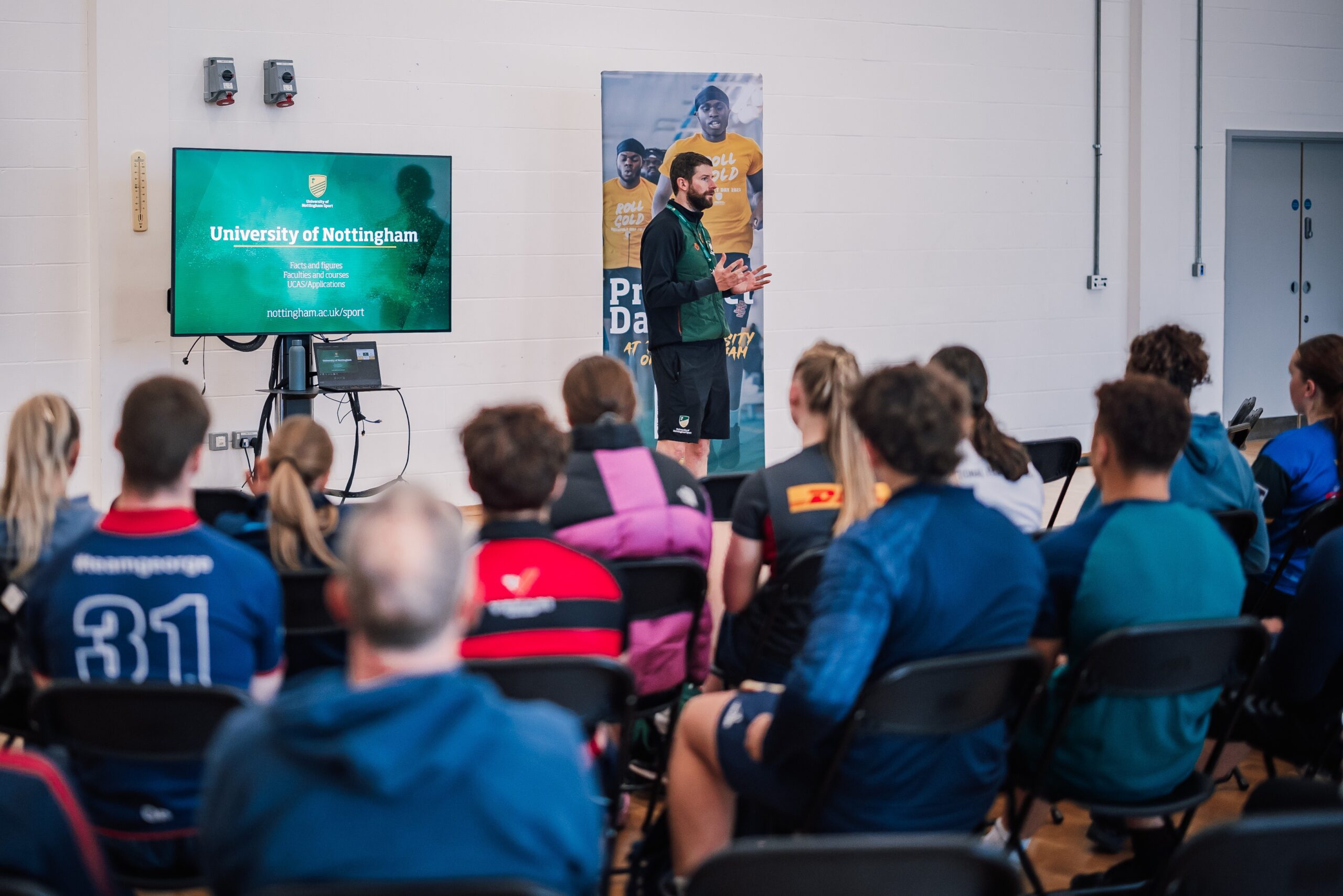
David Knapton, Personal Development Practitioner (pictured right delivering a session to athletes) – explains how it works, how it’s improved engagement and how it’s evolving.
Q: David, can you start by explaining what the workshop programme is and why it was created?
David:
We were very aware that our student athletes have incredibly busy lives. We wanted to create a way to provide support that was both time-effective and cost-effective, while still having real impact. The aim was to help athletes develop as people first, and then as athletes and students. So we created a workshop programme that brings together our whole multi-disciplinary team (MDT) to offer well-rounded, practical support.
Q: What was happening before the workshop programme was introduced?
David:
Before I came into the role, we delivered around six workshops a year, mainly for sports scholars, and they were largely careers-focused. While those were valuable, we knew there was far more expertise across the university and within our MDT that we could tap into. We wanted to build something more holistic — short, practical, one-hour sessions that introduced athletes to different areas of support, from psychology and nutrition to careers and marketing. The idea was to give them accessible knowledge they could use immediately, and also introduce them to the practitioners they could work with one-to-one in future.
Q: Who is the programme delivered to?
David:
We deliver the workshops across our sports scholars and performance teams — around 17 high-performance and performance squads — as well as across our wider club sport network. The intention is that every high-level student athlete at Nottingham can access this support.
Q: How do the workshops benefit athletes beyond just information-sharing?
David:
A big part of the value is that athletes learn from each other. In my personal development sessions especially, students often come up with the best solutions themselves. A first-year student can learn powerful habits from a fourth-year student about time management, organisation or dealing with pressure. It creates a supportive network without forcing it.
Q: Have the workshops increased engagement with one-to-one services?
David:
Yes, definitely. We’ve seen a clear increase in athletes engaging with practitioners after the workshops. Some sessions become particularly popular, and athletes return to develop further or reach out for individual support. The workshops also help break down any nervousness about one-to-one support. Athletes get to meet us in a relaxed environment first and see what we do, which makes it much easier to reach out later.
Q: What types of workshops are most popular?
David:
Psychology and nutrition delivered by Hetty Rudman and Dan Richardson are always the most popular because they directly link to sport performance. We’ve delivered female athlete-specific nutrition sessions, including RED-S education, as well as emotional regulation workshops through psychology. Both received excellent feedback. On the personal development side, I cover areas like organisation, time management, handling difficult conversations and long-term life planning.
Our University careers and employability service deliver tailored CV writing, interview skills and employability sessions specifically for student athletes — not just generic student workshops. Our performance sport marketing team have delivered a workshop on building a personal brand as an athlete, including social media use, and IBM delivered a bespoke session for our students.
Q: You mentioned combining topics — can you give an example?
David:
Yes — one example is a session we ran on fuelling and living on a budget. We used the popularity of nutrition workshops and linked that into budgeting skills. We looked at things like the cost of coffee on campus versus making your own, and how small changes can improve both nutrition and finances. That’s where we’d love to see the programme go more — combined MDT sessions that support the athlete as a whole person.
Q: How have the workshops been received overall?
David:
Last year, we delivered 25 unique workshops and 28 sessions in total, with 387 student attendances. We measure knowledge before and after each session — and on average, knowledge increased from 5.81 to 8.48, which is a really strong improvement. Our end-of-year review achieved a 4.4 out of 5 satisfaction rating for the programme, which was fantastic to see.
Q: Do athletes help shape future sessions?
David:
Absolutely — feedback is vital. This year, students asked for public speaking support, so in Semester 2 we’re delivering a session with the University’s public speaking society. We’ve also had requests around financial education — particularly around investing, sponsorship income, and preparing for late competition selections where costs can arise quickly. We’re exploring that carefully with the right professional voices.
Q: Are there plans for future development?
David:
Yes — one thing we really want to introduce is an alumni speaker series. We’d love former students to come back and talk about where they’ve gone since graduating — whether that’s elite sport, starting a business, or working at major organisations. It’s about showing that being a student athlete isn’t a barrier — it’s often a real strength. Many students worry they lack work experience because of their sporting commitments, but the skills they develop through sport are hugely transferable.
Q: How easy has it been to bring in external departments and organisations?
David:
Surprisingly easy. Most departments are genuinely passionate about supporting athletes and often have their own outreach targets. We’ve worked internally with careers, finance, marketing, and also with international businesses like IBM, all at no cost. Universities already have so many valuable services — it’s just about connecting them. Within our internal sports team, Phil Wood (Recruitment and Scholarship Manager) and Matt Nicholson (Club and Coach Development Manager) have developed excellent relationships with university services.
Q: Could this model work at smaller institutions too?
David:
Yes, definitely. Even if there are fewer athletes, the same workshop model can work by combining scholars, club athletes and performance teams. The key is reaching multiple groups so the sessions remain worthwhile for both students and practitioners. We’re flexible – some of the sessions are opened up to student volunteers and committee members.
Q: What’s been the most rewarding part for you personally?
David:
Seeing athletes walk away with practical tools they can actually use in their lives. If they give up one hour of their week and leave with something that genuinely helps them — that’s a win. It’s also been rewarding working so closely with colleagues across departments and within the sport team. The collaborative element has made the whole programme stronger.
Q: Finally, if other universities wanted to create something similar, what would you say?
David:
Reach out, collaborate, and don’t try to do everything alone. There are so many people across universities and organisations who want to help athletes. I’m always happy to share what we’ve done — the more access students have to quality support, the better.
David Knapton is a Personal Development Practitioner at the University of Nottingham.